
Table of Contents
- Introduction
25 May, 2026
By Dr. Kalpesh Kapadia
Key Takeaways
- An Undescended Testicle is a common condition in newborn boys where one or both testicles do not descend into the scrotum before birth.
- In most cases, the testicle descends on its own within the first 3 to 6 months, but treatment is needed if it does not.
- The ideal age for treatment is between 6 to 18 months for the best long-term fertility and health outcomes.
- Laparoscopic orchiopexy is a modern, minimally invasive procedure offering smaller incisions, less pain, and faster recovery.
- Pratham Urology offers experienced paediatric urology care, accurate diagnosis, and advanced surgical treatment for undescended testicle.
Pratham Urology is one of the most trusted names for parents who notice something unusual during their child's routine check-up and look for expert guidance on Undescended Testicle — focused on delivering accurate diagnosis, gentle care, and advanced treatment options including modern laparoscopic procedures for children.
When a baby boy is born, one of the routine checks doctors perform is a simple physical examination — including a quick look to confirm that both testicles have descended properly into the scrotum. For most babies, this is just a normal step. But for some parents, the doctor's words "one of the testicles has not come down" can suddenly bring a wave of worry. What does it mean? Is it serious? Will it correct itself? Does my child need surgery?
These are completely natural questions, and the truth is — an Undescended Testicle is one of the most common conditions seen in newborn boys, and in most cases, it is very manageable when handled at the right age by an experienced paediatric urology team. At Pratham Urology, we work with many such parents every month, gently guiding them through diagnosis, treatment options, and long-term care.
What Is an Undescended Testicle
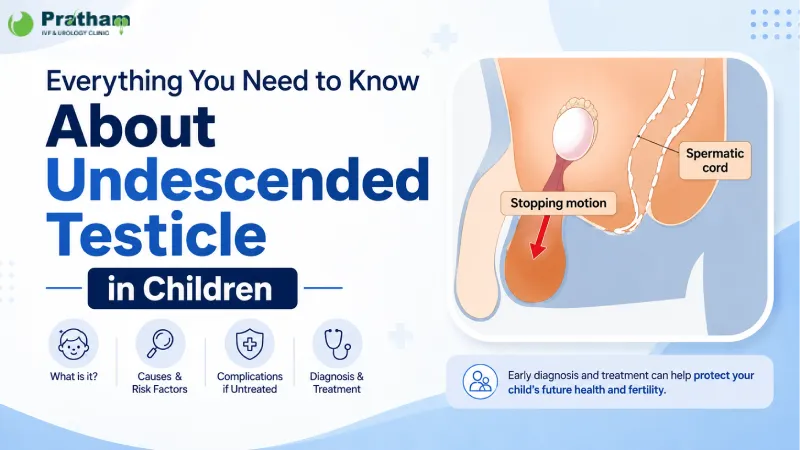
In simple terms, an Undescended Testicle — medically known as cryptorchidism — is a condition where one or both testicles do not move down into the scrotum before birth. During normal foetal development, the testicles form inside the abdomen and gradually descend into the scrotum during the last few months of pregnancy. In some babies, this descent does not happen fully, and the testicle remains either in the abdomen, in the groin region, or somewhere along the path.
It is one of the most common conditions in newborn boys, especially in babies born prematurely. In most cases, the testicle descends on its own within the first three to six months of life. But if it does not come down by then, it usually will not descend without medical treatment — and waiting too long can lead to long-term issues.
Why Parents Should Take This Seriously
An Undescended Testicle is not something to panic about, but it is also not something to ignore. The testicles must be in the scrotum because the temperature there is marginally lower than the bodies, and long-term healthy testicular function depends on this lower temperature. When a testicle remains inside the body, it is exposed to higher temperatures, which can quietly affect its development over time.
If left untreated, an undescended testicle can lead to several future concerns. It can affect fertility later in life, increase the risk of testicular cancer in adulthood, raise the chances of hernia formation, increase the risk of testicular torsion, and cause emotional or psychological discomfort during teenage years. This is exactly why timely consultation with experienced urologists at Pratham Urology genuinely matters for every concerned parent.
What Causes an Undescended Testicle
In most cases, there is no single clear reason behind an Undescended Testicle. It usually happens due to a combination of factors during pregnancy and foetal development. Some of the common risk factors include premature birth, low birth weight, family history of cryptorchidism or genital issues, certain genetic conditions, maternal health issues during pregnancy, and exposure to specific environmental factors.
Parents should remember that this condition is not anyone's fault, and it is something that happens during normal development in a small percentage of babies. The important part is recognising it early and getting the right medical guidance.
How Doctors Diagnose the Condition
Diagnosis is usually quite straightforward and starts with a careful physical examination by a paediatrician or urologist. If the testicle cannot be felt in the scrotum, the doctor checks the groin area to see if it can be located higher up. In some cases, the testicle may not be felt at all from the outside — which usually means it is sitting inside the abdomen and needs imaging like ultrasound for further assessment.
At Pratham Urology, every child is examined with care, patience, and clear communication with the parents. We make sure parents understand exactly where the testicle is located, what the next steps are, and what to realistically expect from the treatment plan.
When and How an Undescended Testicle Is Treated
If the testicle does not descend on its own by 6 months of age, treatment is usually recommended. The ideal age for treatment is between 6 to 18 months, because treating it early gives the best long-term results for fertility, normal function, and overall development.
The most common and effective treatment is a surgical procedure called orchiopexy, where the testicle is gently brought down into the scrotum and fixed in its proper position. For testicles located inside the abdomen, modern medicine offers an even better option — laparoscopic orchiopexy. This is a minimally invasive, advanced procedure where the surgeon uses a tiny camera and small instruments through very small incisions to locate and bring down the testicle.The advantages of laparoscopic orchiopexy include smaller incisions, less pain, faster recovery, minimal scarring, lower risk of complications, and shorter hospital stay — making it the preferred approach for many children today.
Recovery and Long-Term Outcome
The recovery after orchiopexy is usually smooth, especially when the procedure is done early and by an experienced paediatric urology team. Most children go home the same day or after a short stay and return to normal activities within a few days. Mild discomfort, slight swelling, and minor soreness in the area are common and settle quickly with proper care and follow-up.
When an Undescended Testicle is treated at the right age, the long-term outcomes are very encouraging. The testicle continues to grow and function normally in its proper position, fertility prospects improve, and the future health risks are significantly reduced. This is exactly why early consultation and timely treatment matter so much.
Why Choose Us
Here at Pratham Urology, paediatric urology cases like Undescended Testicle are handled with the level of care, patience, and clinical expertise that every concerned parent genuinely deserves. Our team brings years of experience in advanced urology procedures including laparoscopic orchiopexy, and we take time to explain the condition, treatment options, and expected outcomes in simple, clear language that parents can confidently understand. We focus heavily on accurate diagnosis, age-appropriate timing, minimally invasive surgical techniques, gentle post-operative care, and long-term follow-up — so every child receives the kind of focused, compassionate treatment their condition requires. From the first consultation to surgery, recovery, and follow-up reviews, our team stays involved at every step — which is exactly why parents across the region trust Pratham Urology for their child's urology care.
Conclusion
An Undescended Testicle in children is more common than most parents realise — and with timely, expert care, it is a highly manageable condition. The key is not to panic, not to delay, and not to depend on guesswork. A quick consultation with an experienced urology team can give you complete clarity on your child's condition and the safest, most effective treatment path forward. At Pratham Urology, we are committed to delivering child-friendly, advanced urology care backed by clinical expertise, modern surgical techniques, and the genuine sensitivity every parent looks for.
Worried about your child's undescended testicle and looking for expert guidance? Talk to our urology team at Pratham Urology today. Call +91 9726274320 or schedule your appointment for trusted paediatric urology care.
FAQs
UndescendedTesticle Cryptorchidism ChildHealth PaediatricUrology LaparoscopicOrchiopexy PrathamUrology UrologyExperts ChildSurgery PaediatricCare UndescendedTestes