
Table of Contents
- Introduction
19 February, 2026
By Admin
Most men don’t spend much time thinking about their testicles — and honestly, that’s normal. But when something doesn’t feel right, or when a doctor mentions a condition you’ve never even heard of, it can suddenly feel overwhelming. One such condition is an undescended testicle, and while it is often linked to childhood, it can still affect teenagers and adults in ways that are easy to ignore until they become serious.
The truth is that an undescended testicle is not just a “minor” medical detail. It can influence fertility, long-term testicular health, and the risk of complications later in life. The good news is that modern urology offers safe, effective treatment options, including orchiopexy, which helps reposition the testicle into the scrotum where it naturally belongs.
At Pratham Urology, patients are guided through this condition with clarity, privacy, and the kind of calm professional support that makes the process far less intimidating. This blog will help you understand what Undescended Testicle means, why it happens, what risks it carries, and how timely treatment can protect long-term health.
What Is an Undescended Testicle?
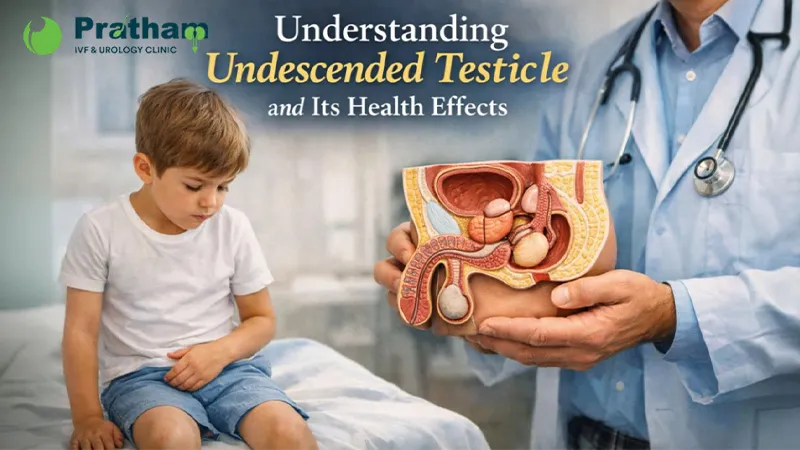
An Undescended Testicle (also called cryptorchidism) is a condition where one or both testicles don’t move down into the scrotum the way they normally should. During pregnancy, testicles develop inside the abdomen and then, usually, they descend into the scrotum before birth or shortly after. When that natural movement doesn’t happen, the testicle may stay higher up — in the groin area, or still inside the abdomen.
For many parents, this is first picked up during a newborn check-up. And yes… that moment can feel sudden. A bit scary. We’ve noticed something over the years though. Not every case is caught right away. Some are missed early on, especially when the signs aren’t obvious, and then it gets discovered later in childhood, adolescence, or even adulthood — sometimes during a fertility evaluation, sometimes during a routine examination, and sometimes just because discomfort finally pushes someone to get checked.
At Pratham Urology, we approach this in a straightforward, medically structured way. But we keep it human. Because honestly, families don’t need complicated talk at that point. We remember how often people walk in confused, trying to figure out what it means and what happens next. So, we focus on what matters. First, we confirm where the testicle is located. Then we look at the patient’s age, symptoms, and overall health. And from there, we decide the best course of treatment — calmly, clearly, and with the kind of guidance people can actually understand, you know.
Why Does This Condition Matter More Than People Think?
It’s easy to assume that if an undescended testicle isn’t causing pain, then it’s probably not a big deal. That’s a very common thought. But this is one of those situations where “silent” doesn’t always mean “safe”. The scrotum exists for a reason. A very real reason. It keeps the testicles at a slightly cooler temperature than the inside of the body, and that small temperature difference plays a big role in healthy sperm production and overall testicular function. When a testicle stays up in the abdomen or the groin for too long, it sits in warmer conditions day after day, year after year — and over time, that heat exposure can affect fertility potential and long-term testicular health in a way most people don’t even realise at first.
There’s another side to this too, and we’ve noticed it matters more than people expect. Monitoring. When the testicle isn’t in the scrotum, it becomes harder to examine properly, harder to keep track of, and honestly… not ideal for catching changes early. We remember many patients coming in later saying they thought “no pain” meant “no problem”, only to find out it needed attention much earlier. This is why Pratham Urology places strong focus on timely diagnosis and proper treatment planning for anyone dealing with Undescended Testicle, whether the patient is a child or an adult. Clear steps. Proper medical structure. No unnecessary delay.
Common Signs and Symptoms of an Undescended Testicle
In many cases, the condition does not cause obvious pain. That’s part of why it can go unnoticed. Still, there are signs that may suggest the need for a urology consultation. Some common signs include:
- One side of the scrotum looks empty or smaller
- A testicle cannot be felt in the scrotum
- Mild discomfort in the groin area
- Concerns noticed during puberty
- Fertility-related issues in adulthood
Sometimes the testicle is not truly undescended but retractile, meaning it moves in and out of the scrotum. This is a slightly different condition, and it needs proper evaluation to determine whether surgery is required. At Pratham Urology, the diagnosis is based on clinical examination and, when needed, imaging. The goal is not to guess — it is to confirm the exact situation before moving forward.
Understanding the Health Effects of Undescended Testicle
The health effects of an Undescended Testicle are the main reason urologists take this condition seriously. While not every patient will face complications, the risks become more relevant when the condition is left untreated for years.
Fertility Concerns
One of the most well-known risks is reduced fertility potential, especially if both testicles are undescended or if the condition remains untreated for a long time. The longer the testicle stays in a warmer environment, the greater the chance that sperm-producing function may be affected. For adult patients, fertility impact varies. Some men still have normal fertility, while others may experience reduced sperm count or quality. This is why evaluation and guidance from a specialist matter.
Risk of Testicular Torsion
Testicular torsion is a condition where the testicle twists, cutting off its blood supply. This can cause sudden severe pain and becomes a medical emergency. An undescended or abnormally positioned testicle may have a higher chance of torsion because it is not properly stabilised in the scrotum.
Increased Risk of Testicular Cancer
This is a topic many people feel anxious about, and it’s important to speak about it carefully and factually. Medical knowledge recognises that an undescended testicle is linked with an increased risk of testicular cancer compared to normally descended testicles. That does not mean cancer will happen, but it does mean monitoring and proper treatment become more important. Surgery helps by positioning the testicle where it can be examined more easily and monitored over time.
Psychological and Confidence-Related Effects
This is not discussed enough, but it matters. For teenagers and adults, an empty scrotum or asymmetry can cause stress, embarrassment, or anxiety about body image. Many patients quietly carry this concern for years without speaking about it. At Pratham Urology, the approach remains respectful and private, which helps patients talk openly without feeling judged.
What Is Orchiopexy and How Does It Help?
Orchiopexy is the standard surgical procedure used to correct an undescended or retracted testicle. The purpose is simple and medically important: move the testicle into the scrotum and secure it in place. During the procedure, the surgeon locates the testicle, gently brings it down into the scrotum, and fixes it using sutures, so it stays in the correct position. Depending on the location of the testicle, the incision may be made in the groin or lower abdomen.
Many patients are surprised to learn that orchiopexy is usually a day-care procedure, meaning patients often go home the same day. Recovery is typically short, and discomfort is usually manageable. At Pratham Urology, orchiopexy is treated as more than “just surgery”. The patient is guided through why it’s needed, what it achieves, what recovery looks like, and how follow-up supports long-term outcomes.
When Is Orchiopexy Recommended?
Orchiopexy is most performed in children, but adults can also require it if the condition was not treated earlier or if the testicle becomes retracted later. The common indications include:
- Undescended Testicle (cryptorchidism)
- Retracted testicle
- Risk of testicular torsion
- Testicular discomfort or pain
- Concerns about fertility or testicular health
The timing of treatment depends on the patient’s age, the location of the testicle, and overall medical assessment. For adults, the urologist may also discuss fertility evaluation and long-term monitoring. At Pratham Urology, patients receive a complete view of the condition, not just a one-line recommendation.
Why This Procedure Is Important for Long-Term Health
Orchiopexy isn’t just something doctors recommend “because it’s standard.” The real reason it matters is what it protects you from long-term — quietly, over time. When the testicle is placed where it’s meant to be (in the scrotum), the body can regulate temperature properly. And that’s a big deal, because temperature plays a direct role in healthy sperm production. It also makes things simpler later on — self-checks are easier, medical exams are easier, and there’s less uncertainty hanging in the background.
Another thing people don’t always realise right away: it helps lower the risk of complications like torsion. That alone is enough to take the procedure seriously. For a lot of patients, the benefit isn’t only physical either. There’s a real sense of comfort that comes with knowing the issue has been handled properly, instead of being left to “maybe cause problems someday.”
And honestly, that’s the biggest point. Orchiopexy takes a condition that can lead to silent, long-term problems and turns it into something manageable — something you can monitor. This is exactly how Pratham Urology approaches it: not just treating what’s happening today but protecting tomorrow’s health too.
What to Expect During Recovery After Orchiopexy
Recovery is usually straightforward, but it still needs proper care. Most patients are advised to rest, avoid heavy lifting for a short period, and follow medication guidance as prescribed. Pain is typically mild to moderate and settles over time. Follow-up appointments are important so the doctor can check healing and confirm that the testicle remains positioned correctly. At Pratham Urology, patients are given clear recovery guidance in simple language, which makes the healing period feel far less stressful. The goal is for the patient to recover comfortably and return to normal routine with confidence.
Why Early Diagnosis Makes a Real Difference
The earlier an Undescended Testicle is identified, the easier it becomes to plan treatment and reduce risks. This is why routine examinations in childhood are important. But even if the condition is discovered later, treatment can still provide meaningful benefits. What matters most is not delaying once the condition is known. At Pratham Urology, patients often say the most helpful part is not only the treatment, but the clarity. When people understand what is happening and what can be done, fear reduces and decisions become easier.
Why Choose Us
Deciding on a urologist for a condition like an Undescended Testicle is not just about the operation - it's about who you can trust with one of the most private and vulnerable aspects of your health. At Pratham Urology, we make sure our patients get a proper, thorough evaluation, as well as a clear explanation of what they've been going through - and a treatment plan that they can really get behind. We know that for a lot of people dealing with a condition like this, there's anxiety, there's shame, there's years of uncertainty about what's going on with their body - and we strive to treat them with the respect and patience they need. From the initial consultation through to guidance on an orchiopexy, and of course the follow-up care afterwards, Pratham Urology is all about delivering safe, expert, and tailored support that actually addresses the whole long-term picture for your testicular health.
Conclusion
At first glance, an Undescended Testicle might look like a small deal - but the truth is, if you leave it unchecked, it can really have serious long-term health implications. There's the fertility stuff, the risk of torsion, and - let's be real - the whole monitoring thing - that's all stuff you really don't want to mess around with. But here's the good news: orchiopexy is a well-established procedure that really can get the testicle back where it belongs, get things working better for you, and all but eliminate the risk of complications further down the line. And when you come to Pratham Urology, you get expert guidance every step of the way, plus care that feels genuinely supportive and reassuring. If you or someone close to you has got an undescended testicle - the sooner they get in to see someone, the better their chances of making the whole process a lot less of a burden.
For expert guidance on Understanding Undescended Testicle and Its Health Effects, call +91 9726274320 or schedule your appointment with Pratham Urology today for trusted urology care.
Key Takeaways
- Undescended Testicle is a medical condition where a testicle does not move into the scrotum as expected.
- Leaving it untreated may affect fertility and long-term testicular health.
- Orchiopexy helps place the testicle in the correct position and supports monitoring.
- The condition can be present in adults, not only children, and still deserves treatment.
- Pratham Urology provides structured evaluation, privacy, and specialist-led care for this condition.